


Urgent apostille for documents
Do You Need an Apostille Urgently?
Understanding how much our clients value their time and want to avoid bureaucratic procedures, our company offers express apostille services. We process apostilles through the following authorities: the Ministry of Internal Affairs, the Moscow Civil Registry Archive, and the Moscow Region Justice Department.
For more than 20 years, our clients have trusted us with a wide range of matters related to document collection, legalization, and translation into foreign languages. We also provide advice on legal issues, represent clients in court, and handle administrative procedures, waiting times, and the completion of applications and forms.
With our comprehensive legal support, you will not have to deal with government or municipal agencies on your own. If your matter is urgent, we can arrange an expedited apostille in the shortest possible time, up to one business day, and send the completed document by courier on the same day we receive it. Submit your request by phone, email, or through our website chat.
What Is an Apostille?
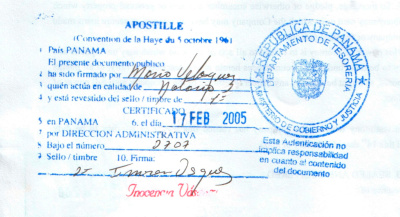
An apostille is the most common form of document legalization. It is a rectangular stamp of a specific size that contains information in the national language of the issuing country. The word APOSTILLE appears at the top in French, and below it is the reference to the Hague Convention.
Since 5 October 1961, the text of the apostille cannot be arbitrary. It must strictly follow the model established by the Hague Convention. This ensures that an apostille is not confused with other stamps, such as notarial or consular stamps.
What Is the Difference Between Consular Legalization and an Apostille?
Before the Hague Convention, there was a consular legalization procedure: a complex, labor-intensive, and time-consuming process that was not universally applicable. Consular legalization is still used today for countries that have not signed the Hague Convention.
In Russia, consular legalization usually consists of six stages:
- A notarized copy of the document is prepared.
- The document is translated into the language of the destination country.
- The translation is certified by a notary.
- The document receives a legalization certificate from the Ministry of Justice.
- The Ministry of Foreign Affairs affixes its legalization seal.
- The consulate of the destination country affixes its legalization stamp.
In other countries, the procedure is somewhat simpler: usually, a stamp from the Ministry of Justice or the Ministry of Foreign Affairs is sufficient. For this reason, an apostille is considered a simplified form of document legalization compared with consular legalization.
Why Is the Apostille a Universal Form of Legalization?
Consular legalization must be repeated each time a document is prepared for a specific country. Unlike consular legalization, an apostille is universal. Once it is placed on a document, it is valid in all countries that are signatories to the Hague Convention.
Does an Apostille Have an Expiration Date?
An apostille itself does not have an expiration date. However, the document it is attached to, such as a criminal record certificate, may have its own validity period.
If a document will only be used in Russia, or generally in the country where it was issued, an apostille is not required. It is needed only when the document is to be presented outside its country of origin.
Which Countries Recognize Apostilles?
An apostille is recognized by all countries that have signed the 1961 Hague Convention, officially titled the Hague Convention Abolishing the Requirement of Legalisation for Foreign Public Documents. This convention removes the need for consular legalization of foreign public documents between participating states.
Among the participating countries are Russia, the United States, almost all European countries, many Latin American countries, India, Japan, Israel, Australia, New Zealand, and Oman. Some countries, including China, the United Arab Emirates, Saudi Arabia, Syria, Canada, and most African countries, have not signed the convention. Several former Soviet republics have signed it as well, including Azerbaijan, Armenia, Belarus, Georgia, Kazakhstan, Kyrgyzstan, Latvia, Lithuania, Moldova, Tajikistan, Uzbekistan, Ukraine, and Estonia.
New countries join the convention from time to time, so it is always a good idea to check the current list of participating states.
If a Document Has an Apostille, Does That Mean It Is Legal?
An apostille confirms the authenticity of the seal and signature of the official who issued the document, but it does not confirm the content of the document itself. To issue an apostille, the authorized authority verifies the authenticity of the seal and signature by comparing them with specimen signatures and seals on file.
For this reason, forged signatures and seals are usually discovered during the verification process. In Russia, the most frequently forged documents include academic diplomas, criminal record certificates, and notarized documents. If you are unsure about the origin of your document, do not submit it for apostille, as it may be retained by the authorities.
Can a Government Agency Refuse to Issue an Apostille?
Yes. An apostille is not issued automatically upon submission of a document. It will be refused if the document was issued improperly, if the person was not entitled to receive it, or if the document is fake.
This often happens with forged diplomas printed on university letterhead. Visually, such a document may look genuine. However, after an inquiry to the relevant university and a request from the Federal Service for Supervision in Education and Science (Rosobrnadzor), it may turn out that the diploma was issued to another person or was never issued at all.
The document must contain the authentic seal and signature of the official. These are compared with the specimens held by the institution authorized to issue apostilles. If such specimens are not available, the agency requests them directly from the issuing organization. The document must also be free of errors, corrections, and deviations from the established form.
What Is the State Fee?
The fee is the same regardless of the issuing authority: 2,500 rubles per document.
If the apostille application is denied, the state fee is not refundable, because the fee covers the review of the application. After the review, the authority issues either a positive or negative decision.
What Are the Deadlines for Obtaining an Apostille?
In Russia, apostilles are usually processed within one to five business days. Educational documents are an exception, as their processing may take up to two months.
Is a Power of Attorney Required If Someone Else Submits the Document?
Under the Hague Convention, any person may act as the applicant, even without a power of attorney from the document owner. In Russia, educational documents are an exception: for apostille processing, a power of attorney from the owner is required.
What If the Document Holder Is a Minor?
If the certificate holder is between 14 and 18 years old, Russian law requires a power of attorney to be executed as follows: the minor and one of the legal representatives, usually a parent, must visit a notary or consul with their passports and the minor’s birth certificate. The notary or consul then certifies both signatures on the power of attorney.
What If the Document Owner Is Abroad and a Power of Attorney Is Needed?
In this case, there are two options: to obtain a power of attorney from a local notary or from a Russian consulate in the relevant country. Each option has its advantages and disadvantages.
Advantages of obtaining a power of attorney at a Russian consulate:
- The power of attorney is issued in Russian, so no further legalization is required and the document can be sent directly to Russia.
- The consular fee is usually much lower than the fees charged by local notaries.
Disadvantages of obtaining a power of attorney at a Russian consulate:
- An appointment is usually required, and the date may be one to two months away, depending on the consulate.
- Russian consulates are typically located in capital cities or other major centers, which may make travel inconvenient and costly.
Advantages of obtaining a power of attorney from a local notary:
- An appointment can often be arranged quickly, allowing the power of attorney to be issued within days.
- Notaries are usually available in many locations, even far from the capital.
Disadvantages of obtaining a power of attorney from a local notary:
- Notary fees are generally higher than consular fees.
- The power of attorney must be issued in the official language of the country and then legalized in Russia, either by apostille or consular legalization.
Important note: An apostille or consular legalization can only be obtained in the country where the document was issued. However, we strongly recommend obtaining a certified translation of a power of attorney issued by a local notary into Russian. It is much easier to produce an accurate legal translation in Russia. Also, even if the translation is made abroad, the notarization text, seal, stamp, and apostille text will still remain in a foreign language, so a fully Russian-language document is not possible if it was issued abroad.
Does a Foreign Notary or a Russian Consul Know What to Write in a Power of Attorney?
Not necessarily. Even if they do, we do not recommend relying on their templates, as they may be outdated, incomplete, or missing important powers. You should provide the consul or notary with a sample of the power of attorney you need so that the document will not be rejected in Russia because of missing details.
There is no such thing as a universal power of attorney. Simply stating that a person may represent the principal before certain institutions is not enough. Every step and every legally significant action of the attorney-in-fact must be clearly stated in the document. In practice, powers of attorney for court or government procedures are often several pages long. That is why professional assistance is usually necessary.
What Is the Correct Procedure for Obtaining a Power of Attorney Accepted in Russia?
Based on many years of experience working with Russian citizens living abroad and with foreign nationals, we have developed a clear process for preparing powers of attorney for different types of assignments.
If you are abroad, the process usually works as follows:
- You decide who will handle your paperwork in Russia, for example, submitting and receiving a diploma for apostille processing.
- You request a power of attorney template from your Russian representative. If the service is provided professionally, the representative should already have a suitable template. For more complex procedures, we prepare the template ourselves or ask the notary to provide one, taking into account the requirements of the relevant Russian authority.
- If you plan to obtain a power of attorney at the Russian consulate, you should make an appointment in advance and bring the sample provided by your representative in Russia.
- If you are signing before a local notary, the Russian text must be translated into the official language of the country where you are located. We prepare such translations and send them to clients in the required foreign language.
- If the power of attorney is issued at the Russian consulate, it only needs to be sent to your representative in Russia.
- If the power of attorney is issued by a local notary, it must be apostilled or legalized by a consular office.
After that, the power of attorney should be sent to your Russian representative, who will arrange a certified translation into Russian through a translation company in Russia. When translating from a foreign language into Russian, it is essential to use the original Russian wording exactly, without changes.
What Documents Can Be Apostilled?
As a general rule, apostilles can be attached to original documents issued by government agencies or notaries. In many cases, they can also be attached to notarized copies of documents. However, not all documents can be apostilled in the form of a notarized copy.
Each notary acts within the legal framework but also exercises personal discretion. Therefore, if one notary refuses to certify a copy, it does not necessarily mean that another notary will refuse as well.
Which Documents Cannot Be Apostilled?
The following documents generally cannot be apostilled:
- Documents issued by commercial entities, such as banks, insurance companies, invoices, receipts, simple contracts, and meeting minutes.
- Documents issued by certain state or municipal bodies, such as medical organizations, local administrations, prefectures, district police departments, customs authorities, and border services.
- Documents without a date, organizational seal, or official signature.
- Unbound documents.
- Documents containing unexplained corrections, typographical errors, illegible text, tears, dirt, wear, or tape repairs.
Which Institutions in the Russian Federation Are Authorized to Issue Apostilles?
Department of Justice
This authority apostilles judicial and notarial documents. Common examples include:
- Judicial decisions and rulings. To obtain an apostille, the decision must have entered into force.
- Notarized consent for a child’s departure.
- Notarized consent of a spouse or former spouse for a transaction.
- Notarial powers of attorney.
- Notarized agreements, such as marriage contracts, alimony agreements, child custody participation agreements, and property division agreements between spouses.
Important: The Department of Justice may apostille both originals and notarized copies of the documents listed above.
Rosobrnadzor
This authority apostilles original educational documents issued in the Russian Federation, as well as in the RSFSR during the USSR. Examples include:
- Secondary education certificates and their supplements;
- Secondary vocational education diplomas and their supplements;
- Higher education diplomas and their supplements;
- Candidate of Sciences diplomas;
- Doctor of Sciences diplomas.
Important: Rosobrnadzor issues apostilles only on the original educational documents listed above.
Important: Diplomas issued by non-state universities can also be apostilled, provided the university is state-accredited and issues diplomas in the established state format. In practice, applications are often denied because of form errors, non-standard forms, or incomplete documentation.
Certificates, transcripts, CVs, and completion certificates for courses or training programs are not apostilled in original form. Educational documents such as certificates and diplomas can be apostilled in two ways: on the original document or on a notarized copy. If the apostille is placed on the original, Rosobrnadzor is the competent authority. If it is placed on a notarized copy, the Department of Justice is responsible.
Civil Registry Office Archive
This authority apostilles state civil status records. The documents include:
- Certificates and notices issued in the established form. The most frequently requested is Form 35, a notice confirming the absence of a civil status record.
This certificate is usually required to confirm that the applicant is single and plans to marry outside the Russian Federation.
- Certificates of marriage, divorce, birth, death, change of name, change of gender, establishment of paternity or maternity, and adoption.
Important: The Civil Registry Office Archive issues apostilles only for the original documents listed above. If you need an apostille for a notarized copy of a civil registry certificate, you must obtain it through the Department of Justice.
Ministry of Internal Affairs
This authority apostilles original documents issued by the main information and analytical centers of the Russian Ministry of Internal Affairs. These are primarily criminal record certificates.
Can You Get an Apostille in Your City?
Some documents can be apostilled locally, while others cannot. The table below shows which Russian authorities can apostille different types of documents.
Authorized body |
Document type |
Where it is located |
Processing time |
Power of attorney required? |
Department of Justice |
Judicial and notarial documents |
Only in the city where the document was issued or processed. |
4–5 business days |
No |
Rosobrnadzor |
Educational documents |
In the city where the document was issued, as well as in the Moscow Department of Education. |
Approximately 45 calendar days |
Yes |
Civil Registry Office Archive |
Certificates, notices, and records |
Only in the city where the document was issued. |
1–5 business days |
No |
Ministry of Internal Affairs |
Certificates of the presence or absence of criminal records |
In the city where the document was issued, as well as in the Moscow Department of Internal Affairs. |
3–5 business days |
No |

Other articles on the topic
View articles

Другие услуги
- Apostilles on civil registry office documents
- Apostilles for MIA (certificate of no criminal record)
- Apostilles from the Ministry of Justice
- Apostilles on education documents
- Obtaining Apostilles on Diplomas
- Obtaining an Apostille Stamp on Education Documents
- Apostilling Education Documents Issued in the USSR